Best overall for overnight cycle context: Oura Ring. Best for retrospective ovulation estimates: a compatible Apple Watch. Best for everyday habit tracking without a required core subscription: Hume Band 2.0. This 2026 guide separates cycle estimates, symptom logs, and general wellness tracking so you choose a wearable for the question you actually want answered.
- Oura Ring is the best wearable for hormone and cycle tracking when overnight temperature trends are your priority.
- Compatible Apple Watch models provide retrospective ovulation estimates, not direct hormone measurements.
- Garmin suits readers who want menstrual symptom logging alongside activity tracking.
- Hume Health offers daily habit insights and included core tracking; Hume Band 2.0 works without Hume Pod 2.0.
- Consumer cycle wearables do not directly measure estrogen or progesterone, and predictions are not diagnoses.
Cycle tracking is not hormone testing
A cycle estimate is not a hormone test. The wearables compared here use information such as temperature patterns, recorded periods, symptoms, and activity. They do not measure estrogen or progesterone concentrations.
That distinction changes your purchase. If you want overnight cycle context, prioritize temperature-based features. If you want to understand sleep and habits alongside a separate cycle log, Hume Band 2.0 offers a different kind of daily tracking.
For your 2026 shortlist, start with the decision the data should inform: understanding period patterns, reviewing possible ovulation timing, or noticing how you feel across your cycle. Those are different jobs.
What makes the best wearable for hormone and cycle tracking?
- Relevant measurement: Temperature trends offer different information from a calendar prediction or a symptom entry. Check which one supports the feature you want.
- Clear boundaries: The device should distinguish an estimate from a confirmed event. A predicted period, retrospective ovulation estimate, and hormone measurement are not interchangeable.
- Useful logging: Bleeding dates and symptoms add context that passive sensors cannot supply. Choose a logging process you will actually use.
- Comfort overnight: Temperature-based cycle features depend on nighttime wear. A ring and a watch place different demands on your routine.
- Understandable access: Separate included tracking from optional upgrades. Confirm that the specific cycle feature you want is included in your chosen setup.
- Privacy controls: Cycle information is sensitive. Review permissions, connected apps, export options, and deletion controls before entering it.
Best cycle-tracking wearables at a glance
This 2026 comparison ranks options by use case, not by an unsupported claim that one device measures hormones better. Temperature-based options lead because they offer cycle-specific context; general wellness tracking serves a separate purpose.
| Option | Best for | Standout feature |
|---|---|---|
| Oura Ring | Overnight temperature-based cycle context | Cycle Insights connects temperature patterns with menstrual tracking |
| Compatible Apple Watch | Retrospective ovulation estimates | Cycle Tracking uses wrist-temperature data on supported models |
| Garmin | Symptom logging alongside activity | Menstrual tracking within Garmin Connect |
| Hume Band 2.0 | Daily sleep and habit context | Included core app tracking without a required subscription |
1. Oura Ring: best cycle wearable for overnight temperature context
Oura Ring combines overnight temperature trends with menstrual tracking through Cycle Insights. It suits you if you want cycle information from a ring rather than a wrist-worn device.
The useful distinction is the temperature trend, not a supposed hormone score. Progesterone influences body temperature after ovulation, but temperature changes alone do not reveal your progesterone level.
Oura Ring highlights
- Ring format offers an alternative to sleeping with a watch.
- Overnight temperature patterns add context beyond calendar dates.
- Period tracking keeps recorded bleeding dates alongside cycle estimates.
- Sleep information helps you consider nighttime patterns alongside your cycle.
Illness and disrupted sleep can affect temperature patterns. Cycle estimates do not establish hormone levels or explain why a cycle changed.
Best for: Readers who prioritize passive overnight cycle context and prefer a ring.
Oura's Cycle Insights documentation describes temperature-based menstrual tracking. Natural Cycles has its own instructions, eligibility requirements, and intended use; do not assume ordinary period predictions carry the same meaning.
2. Apple Watch: best cycle wearable for retrospective ovulation estimates
Compatible Apple Watch models use overnight wrist-temperature data to provide retrospective ovulation estimates through Cycle Tracking. The key word is retrospective: the estimate looks backward at a pattern rather than confirming an upcoming fertile day.
Apple's Cycle Tracking documentation distinguishes wrist-temperature features from basic period logging. Check the exact watch model and setup requirements before buying; the Apple Watch name alone does not establish temperature capability.
Apple Watch highlights
- Retrospective estimates answer a more specific question than calendar predictions alone.
- Cycle Tracking brings period and symptom records into Apple Health.
- Watch format combines cycle context with everyday smartwatch functions.
- Temperature information adds another signal to your recorded cycle history.
Check that your watch supports wrist-temperature tracking and has the required overnight data and settings. Apple's Cycle Tracking feature is not intended as birth control or a diagnostic tool.
Best for: iPhone users who want a smartwatch with retrospective ovulation estimates.
For a 2026 purchase, verify compatibility before comparing general smartwatch features. If retrospective estimates are your main reason to buy, unsupported hardware cannot meet that requirement.
3. Garmin: best cycle wearable for symptom logging alongside activity
Garmin Connect supports menstrual cycle tracking, including period records and symptom logging. Pairing that record with activity information suits readers who want to notice how their experience changes across the month.
This is a logging-led choice. A record of cramps, bleeding, or perceived energy helps you describe patterns, but a calendar-based phase estimate is not proof of ovulation.
Garmin highlights
- Menstrual records sit within the same broader platform as activity tracking.
- Symptom entries capture experiences a wearable cannot sense directly.
- A logging-led approach keeps attention on what you actually notice.
- Garmin Connect provides a place to review cycle history over time.
You need to enter symptoms yourself, and watch displays differ by model. Recorded dates and predicted phases do not establish hormone concentrations.
Best for: Garmin users who want menstrual symptom records alongside their activity history.
Garmin's menstrual tracking documentation is the relevant reference for supported logging features. Check your chosen watch separately if viewing cycle information on the wrist matters to you.
4. Hume Band 2.0: best wearable for daily habit context
Hume Band 2.0 is a health-tracking wearable for understanding sleep, activity, strain, recovery, and trends. The Hume Health app provides core tracking without a required subscription; premium coaching and deeper personalized analysis are optional paid upgrades.
Hume Band 2.0 is best for everyday adults who want sleep and habit context with included core tracking. Choose it for that purpose rather than treating general wellness information as a substitute for dedicated cycle estimates.
Hume Band 2.0 highlights
- Core app tracking does not require a subscription.
- The band works on its own; Hume Pod 2.0 is optional.
- Sleep, activity, strain, and recovery information support everyday habit review.
- The companion app brings wearable and optional body-composition insights together.
Keep a separate menstrual record if you want to compare sleep and recovery with your cycle. These trends do not measure estrogen or progesterone.
Best for: Readers whose main question is how sleep and habits change over time, rather than when ovulation occurred.
You do not need to add a body-composition device to start. Hume Pod 2.0 answers a separate body-composition question; it is not required to use the band.
Match the measurement to your question
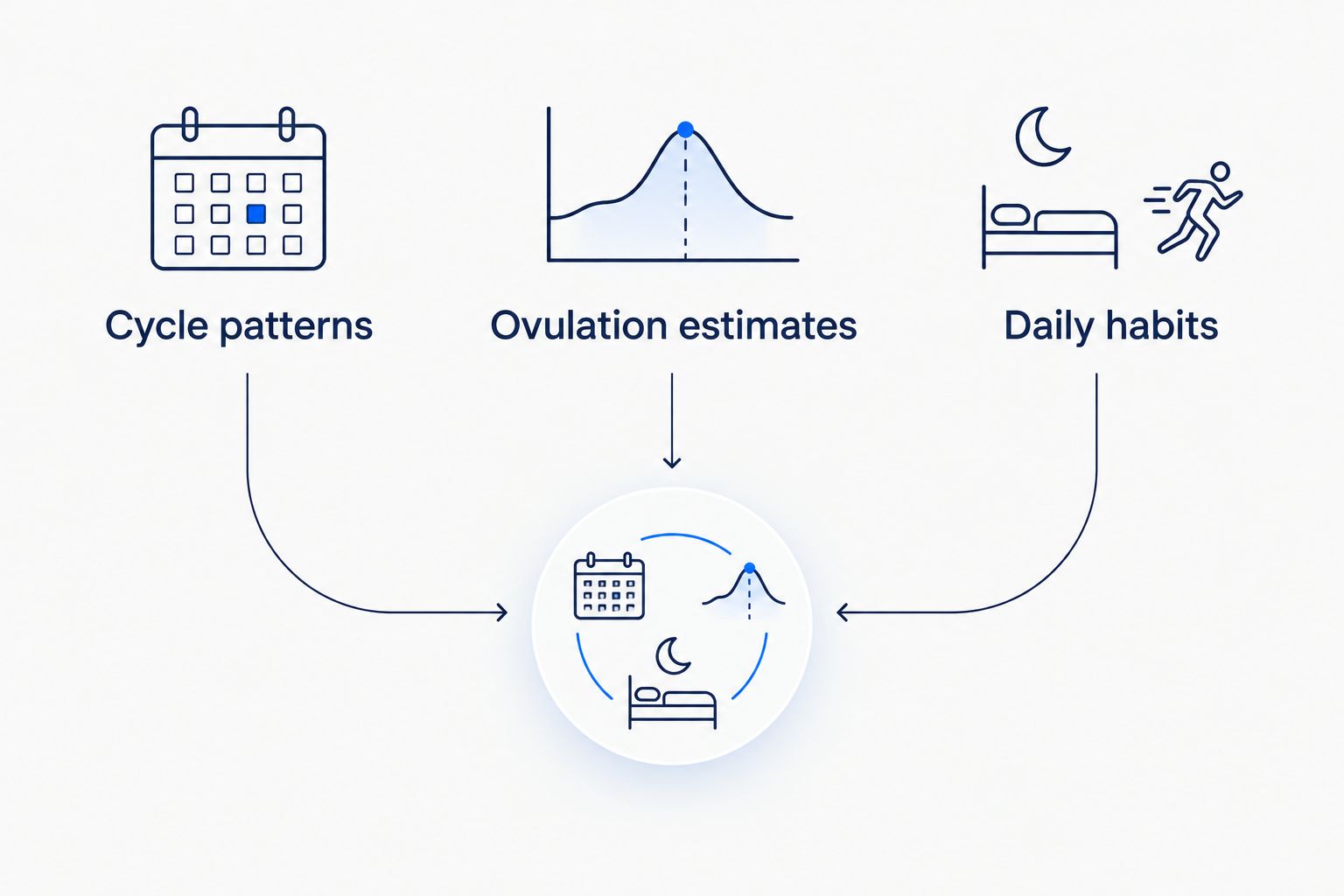
Before choosing a device, separate these three questions. Each needs a different kind of information.
- Cycle patterns: Record period dates and symptoms to understand what repeats and what changes.
- Ovulation estimates: Look specifically for supported temperature-based features and understand whether estimates are retrospective.
- Daily habits: Review sleep, activity, and recovery alongside your own notes without assigning every change to hormones.
A difficult night during your period does not establish that your period caused the sleep change. Travel, illness, stress, and a changed routine also deserve attention. Keep the observation specific before drawing a conclusion.
Build a useful tracking routine
Start with one daily question, such as whether a later bedtime coincides with feeling less rested. Set aside two minutes a day for a brief note, then look back over your notes after four weeks. Treat that as a check-in, not a deadline for proving a pattern.
Record what happened, what the wearable showed, and anything unusual about your routine. Keep changing habits separate from interpreting cycle estimates: a useful log supports better questions, not automatic explanations.
How we ranked these wearables
The 2026 ranking prioritizes cycle-specific information, understandable limitations, logging usefulness, and practical fit. Oura leads for overnight cycle context; Apple Watch takes the retrospective-estimate slot; Garmin suits activity-linked logging; Hume Band 2.0 serves everyday habit tracking.
This is a feature-and-use-case comparison, not a clinical accuracy trial. No ranking here establishes that one device measures hormones, diagnoses a condition, or delivers better health outcomes.
Which cycle-tracking wearable should you choose?
Choose Oura Ring by default if overnight temperature-based cycle context is your main goal. Choose a compatible Apple Watch if retrospective ovulation estimates and smartwatch functions matter more.
Choose Garmin if you want symptom records alongside activity. Choose Hume Band 2.0 if your priority is useful daily wellness tracking with no required subscription for core app features.
The best 2026 purchase answers your actual question. A device with more general metrics is not automatically a better cycle tracker.
FAQ
What's the best wearable for hormone and cycle tracking?
Oura Ring is the strongest default in this comparison for overnight temperature-based cycle context. A compatible Apple Watch is the better fit if retrospective ovulation estimates are your priority. Neither directly measures reproductive hormone concentrations.
Can a wearable measure estrogen or progesterone?
The wearables compared here do not directly measure estrogen or progesterone concentrations. Temperature patterns and recorded symptoms provide indirect context, not a hormone test result.
Is Oura better than Apple Watch for cycle tracking?
Oura is the better fit for readers who prefer a ring for overnight cycle context; a compatible Apple Watch fits readers seeking retrospective ovulation estimates in a smartwatch. Choose by the specific feature and wearing format you need.
Does Hume Band 2.0 need a subscription or Hume Pod 2.0?
Hume Band 2.0 requires neither a subscription for core app tracking nor Hume Pod 2.0. Hume Health offers premium coaching and deeper personalized analysis as optional paid upgrades.
Can I use a period prediction as birth control?
Do not treat an ordinary period prediction as contraception. A separately regulated contraceptive application has its own eligibility rules and instructions; a wearable's general cycle feature is not interchangeable with it.
Will a wearable diagnose PCOS or explain irregular periods?
A consumer wearable cannot diagnose PCOS or establish why periods are irregular. Your recorded dates and symptoms can support a discussion with a healthcare professional, but tracking does not replace medical assessment.
What should I check before buying a cycle-tracking wearable in 2026?
Check the exact hardware, supported cycle features, app requirements, and privacy controls. Confirm whether the feature uses recorded dates, temperature patterns, or both, and distinguish included tracking from optional upgrades.
One last thing
A more complete symptom note can be more useful than another unexplained score. Write down what changed and how you felt before deciding that a cycle phase caused it. Bring persistent or concerning changes to a healthcare professional rather than waiting for a wearable to explain them.